 Sarasota Siding
 What Is LP SmartSide?
LP SmartSide is an engineered wood siding product manufactured by LP Building Products. At its core, it's a wood strand substrate — similar in concept to OSB (oriented strand board) — that's saturated with a resin binder, treated with a zinc borate additive for insect and decay resistance, and finished with a proprietary primer or overlay. It comes in lap boards, panels, and trim, and it's designed to be cut, nailed, and painted much like traditional wood siding, but with better manufacturing consistency than raw lumber.
It's a legitimate, widely used product. Homeowners across the country have it on their homes, and for a lot of climates it performs reasonably well. Our reason for not installing it isn't that it's a bad product — it's that after years of installing and repairing siding on Sarasota County homes, we don't think it's the right long-term match for what Gulf Coast weather does to a house.
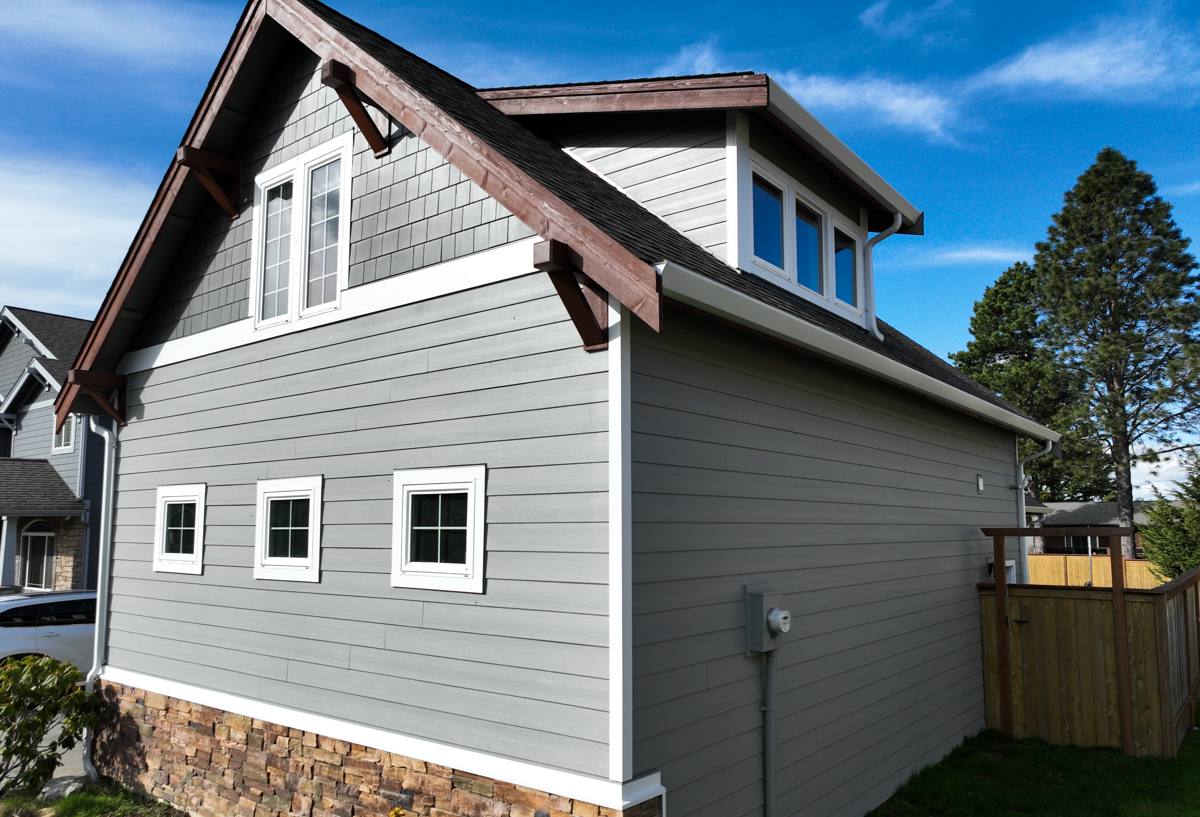
Where LP SmartSide Performs Well
To be fair to the product: LP SmartSide has real advantages, and they're worth naming honestly.
- Lighter weight than fiber cement, which can mean somewhat faster installation in some crews' hands.
- Easier field cutting — it cuts more like wood, without the silica dust and blade wear that fiber cement requires special handling for.
- Lower material cost in most markets compared to premium fiber cement lines.
- Familiar look — it mimics traditional wood lap siding closely, which some homeowners prefer over the slightly different texture of fiber cement.
- LP backs the product with a limited warranty covering fungal decay and workmanship defects when installed to their specifications.
In a drier, more moderate climate, with a crew that follows every detail of the manufacturer's installation manual, LP SmartSide can hold up for a long time. Our hesitation is specific to what happens when that product meets Sarasota's combination of humidity, driving rain, and salt air, year after year.
Why We Made Fiber Cement Our Standard
We install exclusively James Hardie fiber cement siding. That's not a marketing preference — it's a decision built around what we see when we tear old siding off houses in this county. Fiber cement is a mix of cement, sand, and cellulose fibers, pressed and cured into boards. It doesn't have wood grain running through it, and it isn't dependent on a wood core staying dry to stay structurally sound. That single difference drives most of the reasoning below.
The core issue: engineered wood still has wood at its core
LP SmartSide's strand-based substrate is engineered to resist moisture far better than raw lumber, and the factory treatment and resin saturation process is real engineering, not a gimmick. But the product's long-term performance depends heavily on the entire building envelope staying dry — end cuts sealed, caulk joints maintained, flashing detailed correctly, and gutters and grading kept in working order. Fiber cement isn't immune to moisture problems either, but it doesn't swell, delaminate, or feed fungal growth the way a wood-based product can if water finds its way in and stays there.
Field cuts are the weak point
Every piece of lap siding on a house gets field-cut at some point — around windows, doors, corners, and utility penetrations. Factory edges on engineered wood products are treated at the plant; field-cut edges are not, until an installer seals them on site. Miss one, or seal it inconsistently, and that's an entry point for moisture into the substrate. Fiber cement field cuts don't carry the same risk, because there's no wood fiber to protect at the cut edge.
Warranty structure matters as much as the product
Manufacturer warranties on engineered wood siding are typically conditioned on installation following the manual precisely — gaps, fastener placement, caulking schedule, and clearance from grade and roof lines all matter, and deviations can affect coverage. James Hardie's warranty structure for their fiber cement products is built around similar installation requirements, but the material itself has a longer track record of holding its finish and dimensional stability over decades in coastal conditions, which is a big part of why we're comfortable standing behind it.
Sarasota's Climate Is a Stress Test for Any Siding
Sarasota County sits in a spot where several tough conditions stack on top of each other instead of showing up one at a time.
Hurricane-force wind
Wind doesn't just threaten to peel siding off a wall — it drives rain sideways into every seam, joint, and fastener hole on the exterior. Siding here has to handle both wind load and the water that wind pushes with it, sometimes for hours at a stretch during a tropical system.
Wind-driven rain and humidity
Even outside of storm season, Sarasota's humidity keeps exterior materials damp longer than they'd stay in a drier climate. Anything that depends on caulk joints and sealed edges to keep water out is working against a climate that rarely gives those joints a long chance to fully dry.
Intense, near-constant UV
Florida sun is hard on painted and coated surfaces year-round, not just in summer. Finishes that hold up fine in a four-season climate can chalk, fade, or need repainting sooner here simply because the UV exposure is so much higher, so much more of the year.
Salt air
Even homes several miles inland from Sarasota Bay or the Gulf get some salt-air exposure carried on the wind. Salt accelerates the breakdown of fasteners, coatings, and any exposed seams — one more reason we lean toward materials and finish systems built specifically to handle it.
LP SmartSide vs. James Hardie Fiber Cement: Side by Side
| Factor | LP SmartSide (Engineered Wood) | James Hardie Fiber Cement |
|---|---|---|
| Core material | Wood strand substrate, resin-saturated, zinc borate treated | Cement, sand, and cellulose fiber — no wood core |
| Moisture behavior | Resists moisture well if fully sealed; vulnerable if edges or joints fail | Doesn't swell or feed fungal decay from moisture exposure |
| Fire behavior | Combustible, as any wood-based product is | Non-combustible |
| Field-cut edges | Must be sealed on site per manufacturer spec | No wood fiber to protect; less edge sensitivity |
| Finish system | Field-painted or factory-primed, repaint cycle needed over time | ColorPlus factory finish baked on, longer color/finish life |
| Weight / handling | Lighter, easier field cutting | Heavier, requires fiber-cement-rated blades and dust control |
| Material cost | Generally lower | Generally higher, reflected in longer service life |
What We Install Instead — and Why It Holds Up
James Hardie makes climate-specific product lines, including HZ formulations engineered for high-humidity, high-moisture regions like ours. The ColorPlus finish is baked on at the factory under controlled conditions rather than applied on site, which gives it more consistent, longer-lasting color and UV resistance than a field-applied paint job — a real advantage given how much sun a Sarasota exterior takes on. Because the board itself is non-combustible and doesn't rely on a wood core, it holds up to the humidity and salt air here without the same maintenance dependency.
None of that makes fiber cement maintenance-free. It still needs caulk joints inspected, paint touched up eventually if field-painted, and proper flashing and clearances maintained. But the margin for error is wider, and the failure modes we see in the field are less severe when something does get missed.
What to Ask Any Contractor Before You Sign
Whether you go with fiber cement, engineered wood, or something else entirely, these are the questions that actually tell you whether a crew will do the job right:
- Are they installing to the manufacturer's written specification, or their own shortcut version?
- Will field-cut edges be sealed with the manufacturer-specified sealant, every time, not just on visible cuts?
- What clearance will the siding have from grade, roof lines, and decks?
- Is the warranty transferable if you sell the home, and does it cover labor or just material?
- Are they licensed and insured to work in Sarasota County, and can they show proof?
- Do they have a plan for flashing around every window, door, and penetration — not just a general mention of it?
The Bottom Line
LP SmartSide is a real product made by a real manufacturer, and it's not the villain in this story. It's a reasonable choice in a lot of situations. We simply decided, based on what we see on Sarasota County roofs and walls year after year, that fiber cement gives homeowners a wider safety margin against wind-driven rain, relentless UV, and salt air — with less dependency on perfect long-term maintenance. That's the trade-off we're not willing to make on someone else's home, so it's the one product line we install.
If you're weighing your siding options for a Sarasota home, we're happy to walk your property, look at what's on there now, and give you a straight answer about what we'd recommend — no pressure, no obligation. Reach out for a free estimate and we'll talk through what actually makes sense for your house.