 Sarasota Siding
 Exterior Work in The Meadows
The Meadows is one of Sarasota's older established communities, and that maturity shows in the tree canopy — decades of growth that shade the streets and the homes underneath them. That shade is one of the neighborhood's best features, but it also changes how a house's exterior ages compared to a home on an open, sun-blasted lot elsewhere in Sarasota County. Add in the lakes and ponds worked into the community's design, the wind that funnels through when a storm moves across the Gulf, and the general wear that any exterior surface takes in Southwest Florida, and you end up with a set of conditions that reward materials and installation practices built specifically for this kind of environment.
We work on siding, roofing, windows, and decks, and on a property like the ones in The Meadows those four systems are more connected than most homeowners realize. A roof that sheds water poorly overloads the siding below it. Windows that aren't properly flashed let wind-driven rain into the wall cavity behind otherwise sound siding. A deck built with the wrong materials fights the same shade-and-moisture battle as everything else on the lot. We look at the whole exterior, not just the piece a homeowner called about.
What This Climate Does to a Home's Exterior
Shade, Humidity, and Slow Drying
A heavily shaded lot sounds like a break from Florida's punishing sun — and in some ways it is — but shade also means slower drying after rain. Siding and trim under a mature oak canopy stay damp longer than the same materials on an open lot. Over years, that extra dwell time is exactly the condition that breeds mold, mildew, and — for materials that aren't dimensionally stable when wet — swelling, warping, and rot at seams and edges.
Wind-Driven Rain
Sarasota County sits in a corridor that sees tropical systems and strong seasonal storms, and wind doesn't just bring rain — it drives it sideways, up under laps, and into any gap in flashing or trim that wouldn't matter in a gentle rain. Homes in The Meadows aren't directly on the coast, but the wind exposure during a real storm event doesn't care how far inland a lot sits relative to the barrier islands.
UV Exposure
Where a lot does get direct sun — south- and west-facing walls, open backyards, areas where the canopy thins — Florida's UV load is intense and year-round. Paint chalks, fades, and fails faster here than almost anywhere else in the country. Factory-applied, UV-engineered finishes hold up dramatically better than field-applied paint on job-mixed materials.
Salt-Laden Air
The Meadows isn't beachfront, but Sarasota County's air carries salt aerosol well inland from the Gulf, especially during onshore wind events. It's a lower-intensity exposure than a barrier island home faces, but it's still a factor in corrosion on fasteners, hardware, and unprotected metal trim over the life of a house.
Siding: Why Material Choice Matters More Here Than Elsewhere
We install James Hardie fiber cement siding exclusively. That's not a marketing preference — it's a standard we hold because of what we've seen happen to other materials in exactly this kind of climate.
Vinyl siding is affordable and easy to install, but it softens, warps, and can deform under sustained heat and direct sun, and it isn't the product you want between your home and a wind event with real gusts behind it. Wood and primed spruce trim look good on day one but are constantly fighting moisture in a shaded, humid environment — and once rot starts at a seam or a fastener hole, it spreads. LP SmartSide and similar engineered wood products perform better than raw wood but are still wood-based, meaning they're more sensitive to moisture intrusion at cut edges and joints than a true fiber cement product. We don't install any of those, and we don't install Cemplank or Allura fiber cement either — we've standardized on Hardie specifically for its track record, its ColorPlus factory finish, and its HZ5 product engineering for Florida's climate zone.
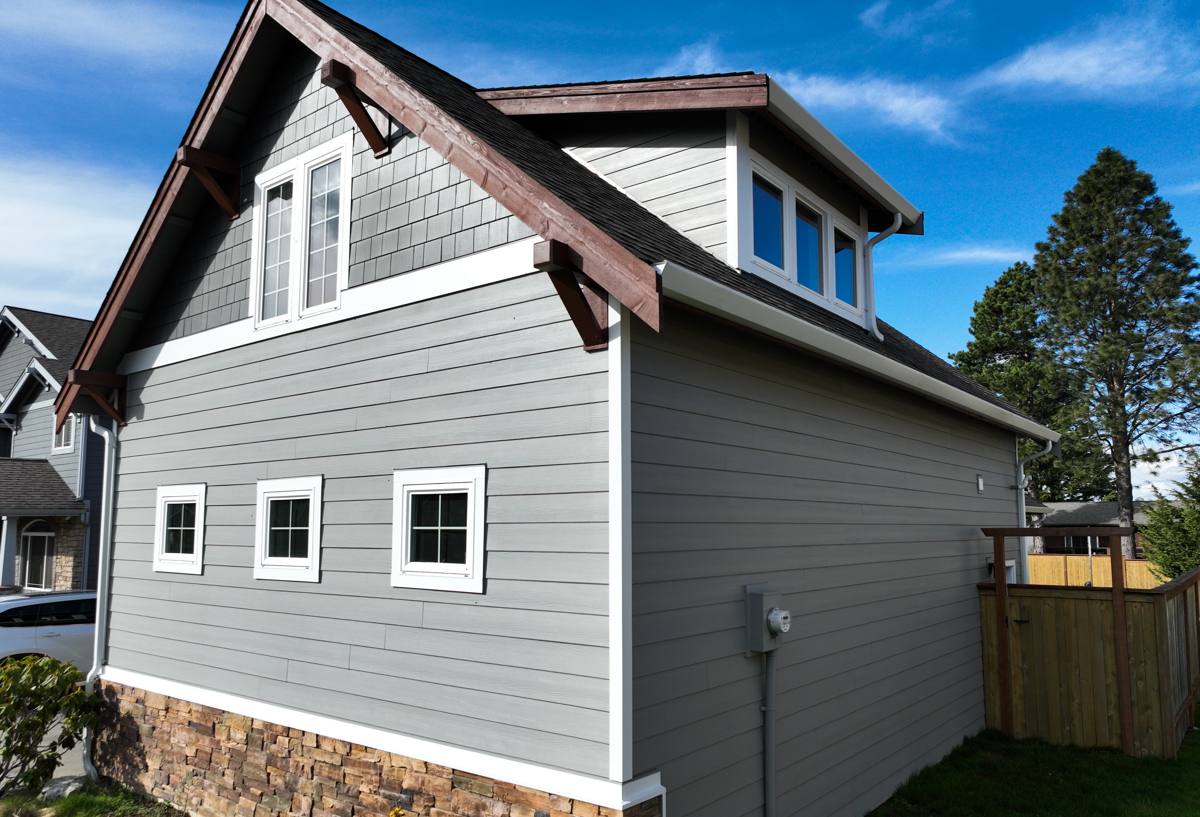
James Hardie fiber cement is non-combustible, doesn't attract termites, and holds up to the humidity-and-sun cycle that wears down other materials. The ColorPlus finish is baked on at the factory under conditions no field-applied paint job can replicate, which matters enormously under Sarasota's UV load. It carries a strong transferable warranty, which is worth something on a resale-minded property in a desirable community like The Meadows.
| Material | How It Handles Sun & Shade Cycling | Moisture Behavior | Typical Lifespan Here |
|---|---|---|---|
| Vinyl siding | Can warp or deform in sustained heat | Doesn't rot, but seams can allow water behind panels | 15-25 years, often less with UV fading |
| Wood / primed spruce | Paint fails faster under Florida UV | Poor — prone to rot in shaded, humid spots | Highly variable, frequent maintenance required |
| Engineered wood (e.g. LP SmartSide) | Better than raw wood, still paint-dependent | Vulnerable at cut edges and joints if not sealed correctly | 20-30 years with diligent maintenance |
| James Hardie fiber cement | Factory-baked ColorPlus finish resists fading | Non-combustible, dimensionally stable, engineered for humid climates | Decades, with strong transferable warranty |
Roofing Under a Tree Canopy
Roofs in a community like The Meadows deal with issues that open-lot homes elsewhere in Sarasota don't face as much: leaf litter and organic debris collecting in valleys, moss and algae growth on shaded slopes, and gutters that need more frequent attention because of what's falling on them year-round. None of that is a reason to avoid a well-shaded lot — it just means a roof needs to be inspected with those conditions in mind, and installed with materials and ventilation that account for slower drying after storms. We check flashing around penetrations and valleys carefully, since that's where wind-driven rain finds its way in first.
Windows: The Quiet Point of Failure
Homeowners tend to focus on the glass — impact rating, tint, efficiency — and those matter. But most water intrusion problems around windows trace back to flashing and installation, not the window unit itself. In a wind-driven rain event, an improperly flashed window will leak long before the siding around it shows any sign of a problem. When we replace windows, we treat the flashing and integration with the surrounding wall system as seriously as the window itself, because that's the detail that actually keeps water out during a real storm.
Decks: Built for Shade and Moisture, Not Against It
A deck on a shaded, tree-lined lot faces the same slow-drying problem as siding — wood decking in particular can stay damp for extended periods after rain, which accelerates rot, mildew staining, and fastener corrosion. We talk through decking material options with an eye toward how much direct sun versus shade a specific yard actually gets, since that changes what maintenance schedule and material choice make sense for the property.
Why a Local Crew Matters
Sarasota County has its own permitting process and wind-load requirements, and a crew that pulls permits here regularly moves faster and avoids the rework that comes from guessing at local code. Beyond permitting, working in neighborhoods like The Meadows day in and day out means we've seen how the tree canopy, the lake-adjacent lots, and the storm exposure actually play out on real homes over time — not just in a manufacturer's spec sheet. That local pattern recognition is part of what a homeowner is paying for when they hire a crew based in the area instead of a traveling storm-chasing outfit.
Signs Your Exterior Needs a Closer Look
- Soft or spongy spots on siding, trim, or decking, especially near seams and fastener locations
- Visible streaking, dark staining, or persistent moss/algae growth on shaded walls or roof slopes
- Paint that's chalking, peeling, or fading unevenly, particularly on sun-exposed walls
- Water stains on interior ceilings or walls near window and door openings after heavy rain
- Gutters overflowing or clogged frequently due to leaf and debris buildup
- Visible gaps, cracking, or separation at siding joints and window trim
- Rust staining around fasteners, hardware, or metal trim pieces
What the Process Looks Like
We start with an on-site inspection of the specific systems in question — siding, roofing, windows, decks, or some combination — and look at how the lot's sun and shade pattern, drainage, and existing materials are actually performing. From there we walk through material and scope options honestly, including cost factors that tend to matter most on a project like this.
| Cost Factor | Why It Matters |
|---|---|
| Extent of moisture damage found | Hidden rot behind old siding or trim adds repair scope before new material goes on |
| Access and lot layout | Mature landscaping, fencing, and tree canopy can affect staging and labor time |
| Material selection | Fiber cement, roofing type, and window specification all vary in material cost |
| Trim and detail complexity | Homes with more corners, dormers, or architectural detail take more labor per square foot |
| Permitting and wind-load requirements | Sarasota County code requirements shape fastening schedules and documentation |
If you're weighing a siding, roofing, window, or deck project on a home in The Meadows, we're glad to walk the property with you and put together a straightforward, no-pressure estimate — just fill out the form below.