 Sarasota Siding
 Why Decks in the Ellenton Area Wear Out Faster
A deck in Ellenton doesn't age the way a deck does in a drier, cooler part of the country. Homes in this stretch of the Gulf Coast, in the broader Sarasota-Manatee region, deal with a specific combination of stressors: hurricane-force winds during storm season, intense year-round UV exposure, wind-driven rain that gets pushed sideways into places it was never meant to reach, and salt-laden air that speeds up corrosion on anything metal. None of these forces are dramatic on their own from one week to the next, but stacked together over several Florida summers, they're what turn a solid deck into one with soft boards, loose railings, and rusted-out hardware.
Deck repair here isn't just cosmetic touch-up work. It's diagnosing which of these forces did the damage, how far it's spread underneath the surface, and what actually needs to be replaced versus what can be properly restored. That distinction matters, because a repair that only addresses what's visible on top often leaves the real problem sitting untouched underneath.
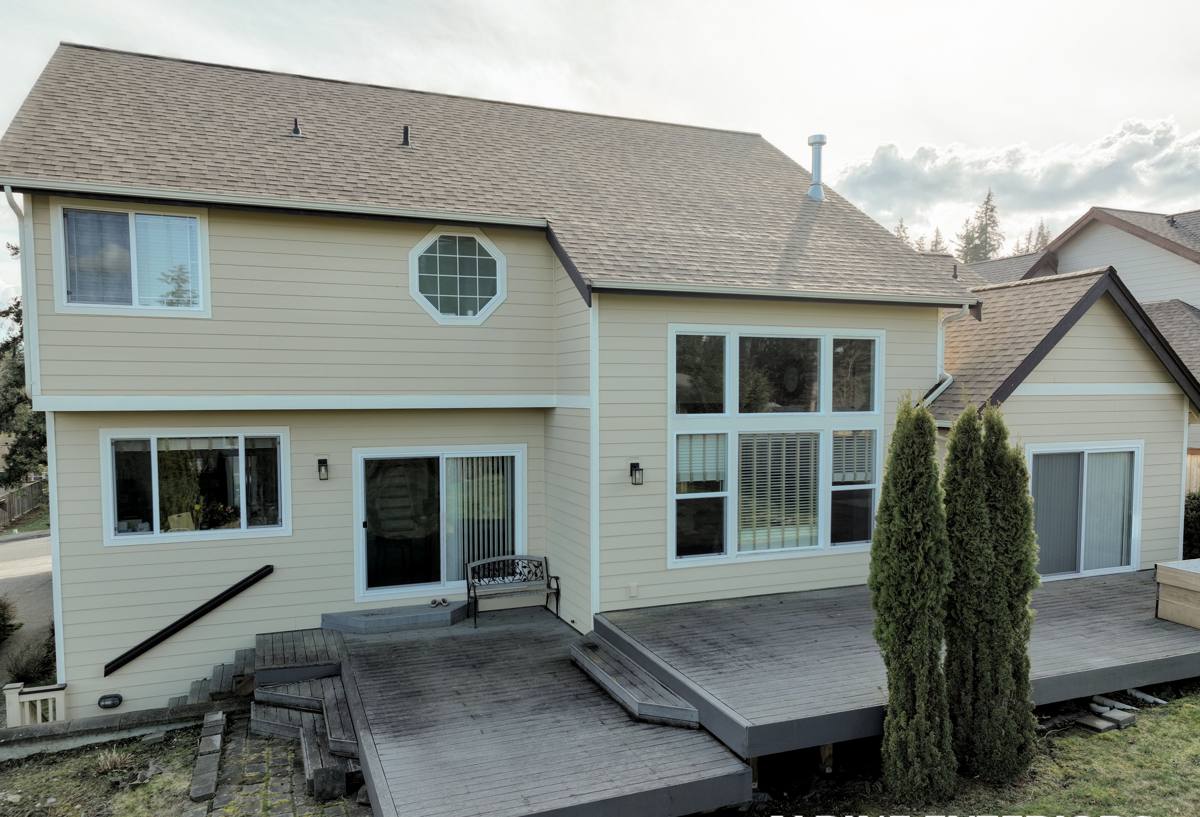
How Decks Actually Fail in This Climate
UV and Heat
Constant sun exposure breaks down the lignin in wood fibers and degrades the UV inhibitors in composite and PVC decking over time. On wood decks this shows up as graying, splintering, and surface checking. On composite boards it can mean fading, chalking, or a surface that's gone brittle even though the core looks fine. Heat also accelerates the drying and cracking cycle in fasteners' surrounding wood, which loosens screws and nails faster than in milder climates.
Wind-Driven Rain and Moisture
Florida rain rarely falls straight down. Wind pushes it sideways and upward into board gaps, under railings, and behind ledger boards where a deck attaches to the house. That's where rot does its real damage, because it's hidden. A deck can look presentable from a few feet away while the framing underneath is holding moisture and slowly failing.
Salt Air and Corrosion
Being close to the Gulf means airborne salt settles on everything outdoors, including deck hardware. Standard fasteners, brackets, and joist hangers corrode faster here than they would inland. Once a fastener rusts, it loses grip strength long before it looks bad enough to worry most homeowners, which is part of why deck problems in this area tend to be more structural than they first appear.
Wind Load and Storm Stress
Every wind event puts cyclical stress on a deck's connection to the house and its posts and footings. A deck that was built to code and properly maintained handles this fine. One with a weak ledger connection, undersized fasteners, or footings that have shifted over the years is the kind that develops problems after storm season, sometimes to a serious degree.
What a Correct Deck Repair Actually Involves
A repair done right starts underneath, not on the surface. Before any board gets replaced or any railing gets tightened, the framing needs a real inspection:
- The ledger board connection to the house, since this is the single most common point of structural failure on an attached deck
- Joists and beams, checked for soft spots, rot, and proper spacing
- Posts and footings, checked for movement, cracking, or inadequate embedment
- Fasteners and hardware, checked for corrosion and whether they're rated for the load and the coastal environment
- Railings and guards, checked against code height and baluster spacing requirements, since these are safety items, not aesthetic ones
Only after that framing inspection is complete does it make sense to talk about decking boards, refinishing, or cosmetic repair. A contractor who skips straight to replacing the boards you can see, without checking what's underneath, is doing surface work on what might be a structural problem.
Fastener and hardware selection matters more here than in most parts of the country. Standard zinc-coated screws and brackets corrode faster in salt air, so a repair that's built to last should use stainless steel or properly rated hot-dip galvanized hardware in place of whatever was used originally, especially on ledger connections, joist hangers, and post bases.
Repair or Replace? A Practical Breakdown
Not every deck problem calls for a full rebuild, but not every problem is fixable with a few new boards either. Here's a general guide to how that decision usually plays out:
| Situation | Repair Is Usually Enough | Replacement Is Usually Needed |
|---|---|---|
| Surface boards | A handful of cracked, cupped, or splintering boards in isolated spots | Widespread cupping, splitting, or soft spots across most of the deck surface |
| Framing | Isolated soft spots in one or two joists | Rot found in multiple joists, the ledger board, or main support beams |
| Fasteners | Visible surface rust with hardware still structurally sound | Corroded fasteners that have lost grip strength or are pulling loose |
| Posts and footings | Minor movement correctable with reinforcement | Footings that have shifted, cracked, or no longer meet the post properly |
| Railings | Loose balusters or a wobbly section | Railing system that doesn't meet current code height or spacing |
| Age and history | Deck is under 10-15 years old with a documented maintenance history | Deck is older, has unknown build history, or has failed prior repairs |
These are general guidelines, not guarantees. The only way to know for sure which category a given deck falls into is a hands-on inspection, since rot and hardware failure are frequently worse underneath than they look from the top.
Checklist: Signs Your Deck Needs a Repair Call
Most homeowners don't inspect their deck framing regularly, which is understandable. These are the warning signs worth taking seriously enough to get it looked at:
- Boards that feel spongy, bounce, or flex underfoot in a specific spot
- Visible gaps, separation, or rust streaks where the deck meets the house
- Railings or posts that wobble or feel loose when pushed
- Nails or screws that have backed out, or visible rust around fastener heads
- Persistent dark staining, mildew, or a musty smell near the deck's base or ledger
- Stairs that feel less solid than they used to, especially at the stringer connections
- Visible daylight or gaps where flashing should be sealing the ledger board
- A deck that was built or last inspected more than a decade ago with no maintenance records
Any one of these on its own isn't necessarily an emergency, but it's worth having checked before the next storm season rather than after.
Decking Material and Repair Considerations
What a deck is built from changes how it fails and how it should be repaired. Matching new material to old, and understanding each material's behavior in this climate, is part of doing the repair correctly rather than just patching it.
| Material | Common Repair Issues Here | Repair Considerations |
|---|---|---|
| Pressure-treated wood | Splitting, cupping, surface checking, rot at ground contact and fastener points | Requires periodic sealing; damaged boards should be replaced individually with matched, properly rated lumber |
| Composite decking | Fading, surface wear at board ends, moisture intrusion at cut edges without proper capping | Repairs should match existing board profile and color batch as closely as possible; cut ends need to be properly sealed or capped |
| PVC decking | Generally more moisture-resistant, but can show heat expansion issues or fastener pull-through | Requires correct fastener spacing to account for thermal movement; not all repair fasteners are compatible |
| Framing lumber (any surface) | Hidden rot at ledger, joists, and posts regardless of what the surface decking is | Should be inspected independently of the surface material, since surface condition doesn't reliably indicate framing condition |
We generally steer homeowners toward matching repairs to what's already on the deck rather than mixing materials, since different decking products expand, contract, and age differently. Mixed materials on one deck can create uneven wear patterns and make future repairs more complicated to plan around.
How Our Deck Repair Process Works
- Inspection. We check the full structure, not just what's visible, including ledger, framing, fasteners, and posts.
- Written scope. We explain what's actually wrong, what's causing it, and what it will take to fix it correctly, in plain terms.
- Permitting, if needed. Structural repairs, such as ledger, framing, or footing work, typically require a permit through the local building department. We handle that process.
- The repair itself. We replace what needs replacing, using corrosion-resistant hardware suited to a coastal climate, and reinforce connections that are original weak points rather than just swapping like for like.
- Final walkthrough. We check the completed work with you before considering the job done, including railing stability, board fastening, and overall solidity underfoot.
We don't upsell a full rebuild when a targeted repair will genuinely hold up, and we don't patch over a structural problem to make it look finished. The goal is a deck that's actually safe and sound, not just one that looks fine until the next storm.
Permits and Building Code in This Area
Florida's building code sets wind load requirements that are meaningfully stricter than what's used in most of the country, and those requirements apply directly to how a deck's ledger, framing, and railing connections need to be built or repaired. Structural deck repairs, including anything touching the ledger board, support posts, footings, or load-bearing framing, generally require a permit and inspection through the local building department serving your area.
This isn't a box to check for its own sake. Permitted, inspected work means a third party has confirmed the repair meets current wind and structural standards, which matters in a region where hurricane-force wind events are a real and recurring possibility rather than a rare edge case. A contractor who skips permitting on structural repairs to save time is passing that risk on to you.
Why Hire a Crew That Already Works in Ellenton
Deck repair work in this area comes with a learning curve that isn't obvious from the outside. Homes here span a range of ages and construction styles, and older decks in particular were often built to a different, less demanding wind and moisture standard than what's required today. A crew that regularly works decks throughout Ellenton and the surrounding Sarasota-Manatee area has already seen how local construction practices from different decades hold up, what tends to fail first, and where a "repair" quietly needs to become a partial rebuild to actually be safe.
There's also a practical side to hiring local. A contractor based in and around Sarasota can respond faster after a storm, is familiar with the permitting process at the local building department, and isn't learning the region's climate behavior on your project. That familiarity shows up in fewer surprises mid-repair and a scope of work that's realistic from the first inspection, not one that grows once the boards come up.
Get an Honest Look at Your Deck
If your deck has soft spots, loose railings, or you're just not sure how it's holding up after another Florida storm season, we'll come take a real look and give you a straight answer, not a sales pitch. Reach out for a free, no-pressure estimate using the form below.