 Sarasota Siding
 Why Venice Decks Take More Punishment Than Decks Inland
Venice sits right on the Gulf, which means any deck here is doing double duty: it has to look good and hold up to a coastal climate that doesn't let up. Between the intense year-round UV, wind-driven rain off the water, salt air working into every seam and fastener, and the real possibility of hurricane-force winds during storm season, a deck built to "national average" standards tends to show its age fast in this part of Sarasota County. Boards fade unevenly, fasteners corrode, and structures that were never engineered for wind uplift start to loosen at the ledger board within a few seasons.
None of that is a reason to avoid outdoor living space — it's a reason to build it correctly the first time. Composite decking, when specified and installed with this climate in mind, is one of the more durable choices available for a Venice backyard, patio extension, or pool deck. The key is understanding what "correctly" actually means here, not just installing it the way it would go in on a dry, moderate site.
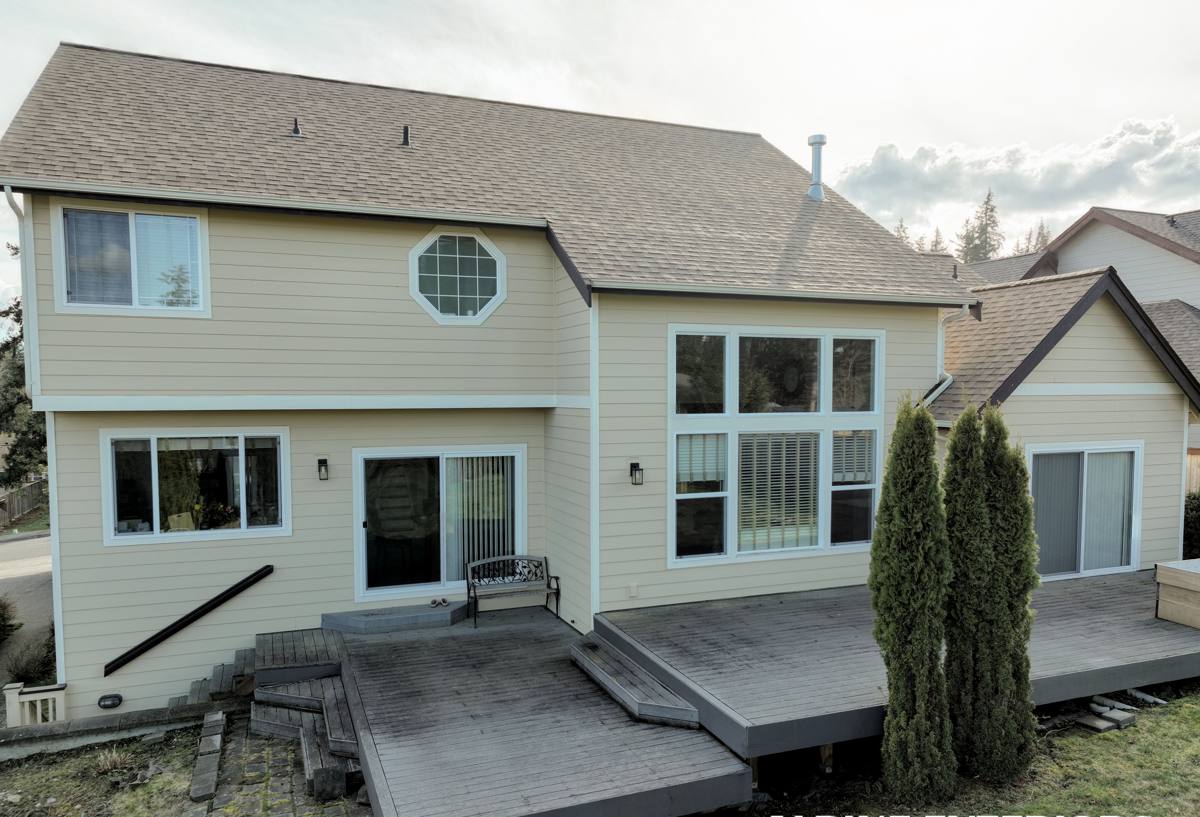
What Composite Decking Brings to a Coastal Property
Composite decking is a blend of wood fiber and plastic, capped or coated to resist moisture, UV, and staining. For Venice homeowners, the appeal isn't just low maintenance — it's that the material behaves more predictably than solid wood in a humid, salt-exposed environment.
Why it holds up better than wood here
- The plastic component doesn't absorb water the way wood does, so it's far less prone to swelling, cupping, and splitting from humidity swings and wind-driven rain.
- Capped boards resist UV fading better than uncoated wood, which matters under Florida's sun load — though even capped composite will mellow slightly over years of full sun exposure.
- No sanding, staining, or sealing cycle. In a climate where wood decks often need re-staining every year or two just to keep moisture out, that's a real difference in ongoing labor.
- Consistent board dimensions mean tighter, more predictable gapping — which matters for both drainage and appearance on a covered or partially shaded deck.
Composite isn't maintenance-free, and we won't tell a homeowner it is. It still needs periodic cleaning to keep salt residue and organic buildup from dulling the surface, and the substructure underneath it — the part nobody sees — matters just as much as the boards on top.
Choosing the Right Board for a Gulf-Facing Property
Not all composite decking is built the same, and the differences matter more in Venice than they would somewhere without salt air and intense sun. Some lower-grade boards use a capping process that doesn't fully wrap the board, leaving cut ends or edges exposed to moisture intrusion over time. Others use core materials more prone to moisture absorption at the plank ends, which is exactly where salt-laden humidity does its work.
| Factor | What to Look For | Why It Matters in Venice |
|---|---|---|
| Capping | Fully wrapped (all four sides) vs. three-sided cap | Fully capped boards resist moisture wicking at cut ends, which matters with salt humidity and frequent rain |
| Color/UV rating | Manufacturer-rated fade resistance, warranty coverage for fading | Year-round direct sun accelerates fading more than seasonal climates |
| Board profile | Grooved (hidden fastener) vs. solid edge | Grooved boards need clean, debris-free grooves to drain properly under wind-driven rain |
| Hardware compatibility | Marine-grade or coated stainless fasteners and clips | Standard fasteners corrode faster in salt air, leading to streaking and loosening |
| Warranty structure | What's covered (fading, staining, structural) and for how long | Coastal exposure is often specifically addressed — or excluded — in the fine print |
We walk homeowners through these trade-offs during the estimate rather than defaulting to whatever's cheapest per foot. A board that saves money up front but isn't fully capped or doesn't have a warranty that accounts for coastal exposure usually costs more in the long run — either in appearance or in repairs.
Board tiers, in plain terms
Most composite lines fall into a few honest categories: entry-level boards with basic capping and shorter warranties, mid-tier boards with full capping and better fade resistance, and premium lines with the longest warranties and the most consistent coloring over time. Pricing scales with those differences, and it varies enough by manufacturer, board profile, and current material costs that we'd rather give a written, project-specific number than a generic figure that doesn't hold up once we've seen your site.
What a Correct Installation Actually Involves
The boards get the attention, but the structure underneath is what determines whether a deck survives a bad storm season. This is where we see the biggest gap between a fast job and a right job.
Substructure and framing
Joists, beams, and posts need to be sized and spaced for both the load and the wind exposure of a Gulf-facing lot — not just the minimum spacing printed on a composite board's install guide. We use fasteners and structural connectors rated for exterior, coastal use, and we tie framing to the structure with hardware sized for wind uplift, not just gravity loads.
Ledger attachment and flashing
Where a deck attaches to the house, proper flashing keeps wind-driven rain from working its way behind the ledger board and into the wall assembly. This is one of the most common shortcuts on older or storm-damaged decks we get called to fix — a ledger that was lag-bolted on without proper flashing, sitting there quietly letting water in behind the siding for years.
Fasteners and hardware
Standard galvanized hardware corrodes faster near the Gulf than it would inland. We spec stainless or coated hardware rated for coastal/marine exposure on the connections that matter — joist hangers, ledger bolts, post bases — even where it costs a bit more than the minimum-code option.
Spacing, gapping, and drainage
Composite boards expand and contract with heat, and Florida sun means real thermal movement across a deck surface. Gapping has to account for that, and the substructure needs to allow water to actually drain and air to circulate underneath — standing moisture under a deck is one of the fastest ways to shorten its life, composite or not.
Permitting and wind-load compliance
Sarasota County has permitting and inspection requirements for deck construction, and those requirements exist largely because of wind exposure. We pull the proper permits and build to what inspectors are actually checking for — this isn't paperwork we skip to move faster.
How We Approach a Venice Decking Project
The process is straightforward, and we keep it that way on purpose:
- On-site assessment. We look at your existing structure (if there is one), the exposure of the site to sun and wind, drainage around the footprint, and how the deck ties into the house.
- Honest material walkthrough. We show you real board options and explain the differences in capping, warranty, and expected performance in this climate — not just color swatches.
- Written estimate. Scope, materials, hardware grade, and timeline in writing before anything starts.
- Permitting. We handle the permit process with Sarasota County so the project is inspected and compliant, not just "done."
- Build. Framing and substructure first, inspected before boards go down, then decking, fastening, and finish details.
- Final walkthrough. We go over the finished deck with you, including basic care so it looks right for years, not just for the first season.
Living With a Composite Deck in This Climate
Composite is low-maintenance, not no-maintenance. A few habits keep a Venice deck performing the way it should:
- Rinse off salt residue and organic debris (leaves, pollen, mildew film) periodically — a garden hose and soft brush handle most of it.
- Keep planters, grills, and furniture feet from trapping moisture or debris against the board surface for long stretches.
- Check under the deck once or twice a year for debris buildup that can block drainage or trap moisture against framing.
- Inspect fastener heads and hardware periodically, especially after a major storm, for corrosion or loosening.
- Trim back vegetation that shades the deck constantly — persistent shade plus humidity is a good recipe for surface mildew, even on composite.
Mistakes We See on Existing Decks Around Venice
A lot of our repair and replacement calls trace back to a handful of recurring issues, and they're worth knowing before you build or rebuild:
- Ledger boards attached without proper flashing, allowing water intrusion into the house structure over time.
- Standard (non-coastal-rated) fasteners used on a Gulf-facing property, leading to visible rust streaking and weakened connections.
- Undersized framing that technically meets minimum code but wasn't sized with real wind exposure in mind.
- Boards installed without adequate gapping, causing buckling or surface stress as they expand in summer heat.
- No airflow or drainage path underneath the deck, leading to trapped moisture and premature substructure decay.
None of these are complicated to avoid — they just require building to the site's actual conditions instead of a generic install guide.
Why It Matters That a Crew Already Works This Area
A contractor who works Venice and the surrounding Sarasota County coastline regularly already knows which hardware grades hold up here, what the county's permitting process expects, and how a deck needs to be engineered differently a mile from the Gulf than it would be forty miles inland. That's not something you can fully substitute with a generic install manual, even a good one. We've built and repaired enough decks along this stretch of coast to know where the shortcuts usually get taken — and to build past them the first time, so you're not paying twice.
Local also means accountability. If a fastener starts showing early corrosion or a board isn't sitting right after a storm, you're calling a crew that's still working in your neighborhood, not chasing down someone who did a one-off job and moved on.
If you're planning a new deck or replacing one that hasn't held up to Venice's climate, we're happy to take a look and give you a straightforward, written estimate — no pressure, no upsell on materials you don't need. Use the form below to get started.